


Challenge
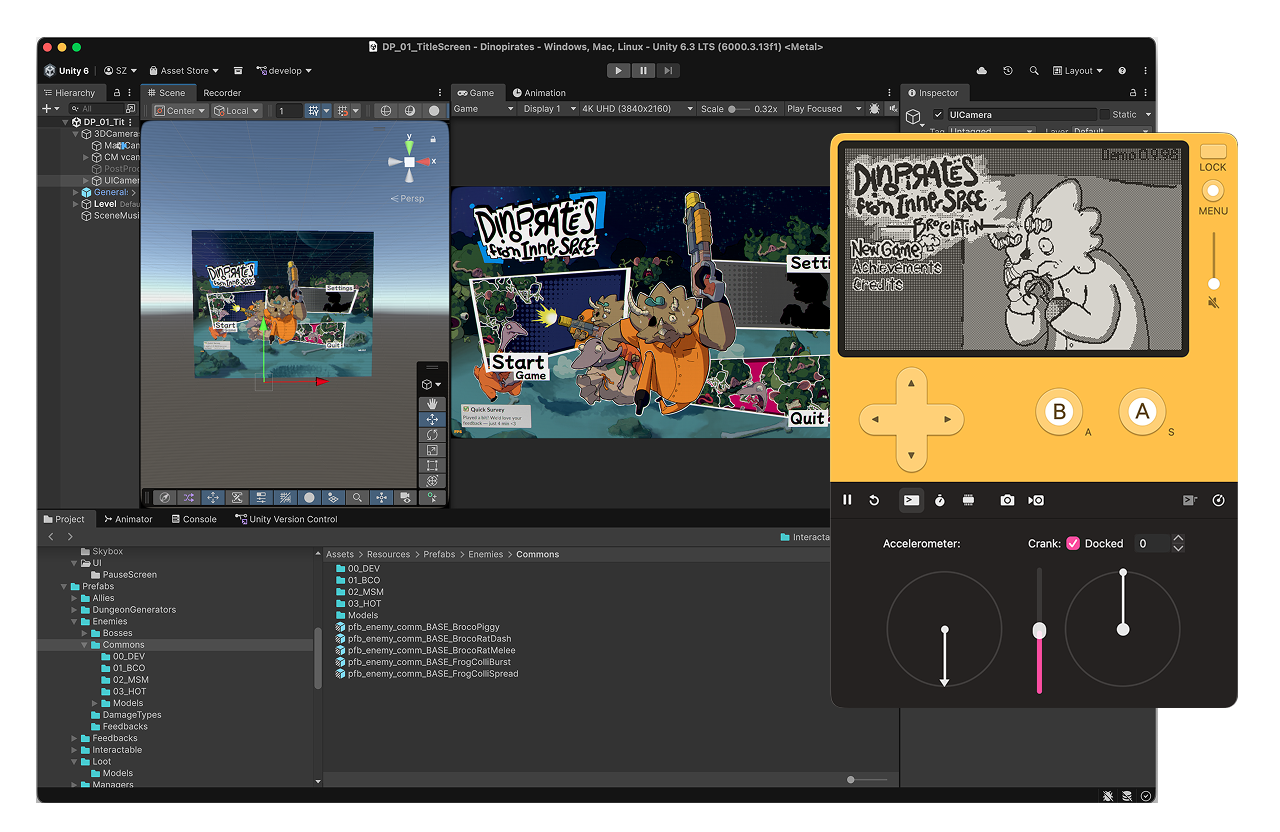
Build a game universe across two distinct platforms from scratch: a hardware-constrained 1-bit Playdate game as sole designer, developer and art director, and a commercial action roguelike for Steam where I led art direction, character design and UI alongside a team in Chile. Each version required owning a completely different part of the stack under completely different constraints.
Overview
Dinopirates from Inner Space is a game universe built around one premise: dinosaurs in space, who are also pirates. That premise has produced two distinct games on two distinct platforms, each with its own design language, constraints, and goals.
The Playdate version is a solo indie adventure game: 900+ commits, 150 Lua source files, four gameplay modes, and a demo shipped at BitSummit 2025 in Kyoto.
The Unity version is a commercial action roguelike in development for Steam, built with a team in Chile. TriceraTreasure Tom, a disgraced Dinopirate demoted to janitor, fights his way back to captaincy through the Inner Space. My contribution was art direction, character design, and UI, not the engineering.
Both games share the same IP. The role and the constraints are different on each.
Playdate
Designing for 1-bit
Every design decision on the Playdate is an exercise in subtraction. There is no color. There is no alpha channel. There are pixels, and they are either on or off.
The main character changed early on from a Styracosaurus to a Triceratops, not for story reasons, but because the Triceratops reads better at the resolution the game runs at. The horns are legible at 16×16 px. The Styracosaurus spines are not. This is the kind of decision that defines 1-bit design: biological accuracy loses to pixel clarity every time.
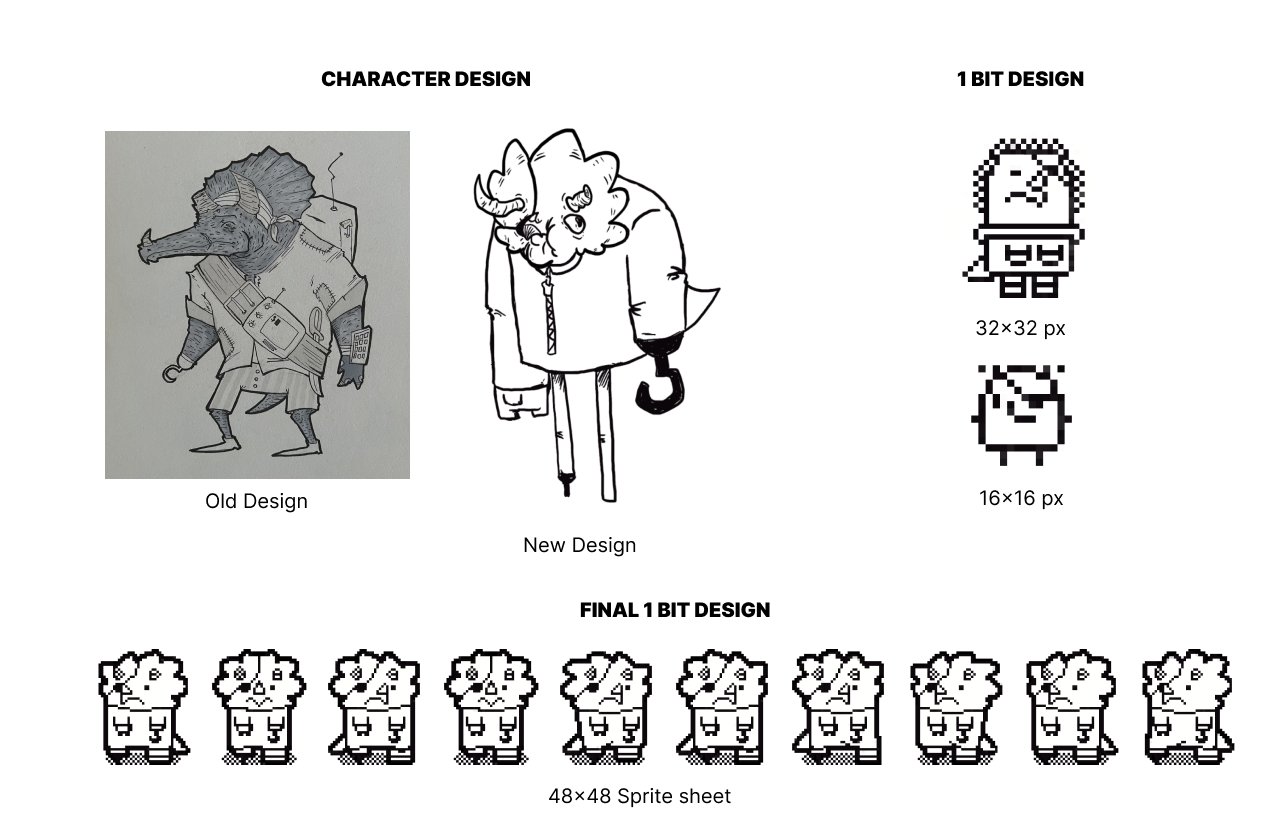
The Brocolliens follow the same logic. Their silhouette reads as broccoli. Their animations are minimal. The limited palette forces you to communicate personality through shape, proportion, and timing alone, which turns out to be a better design exercise than most.
UI on a tiny screen
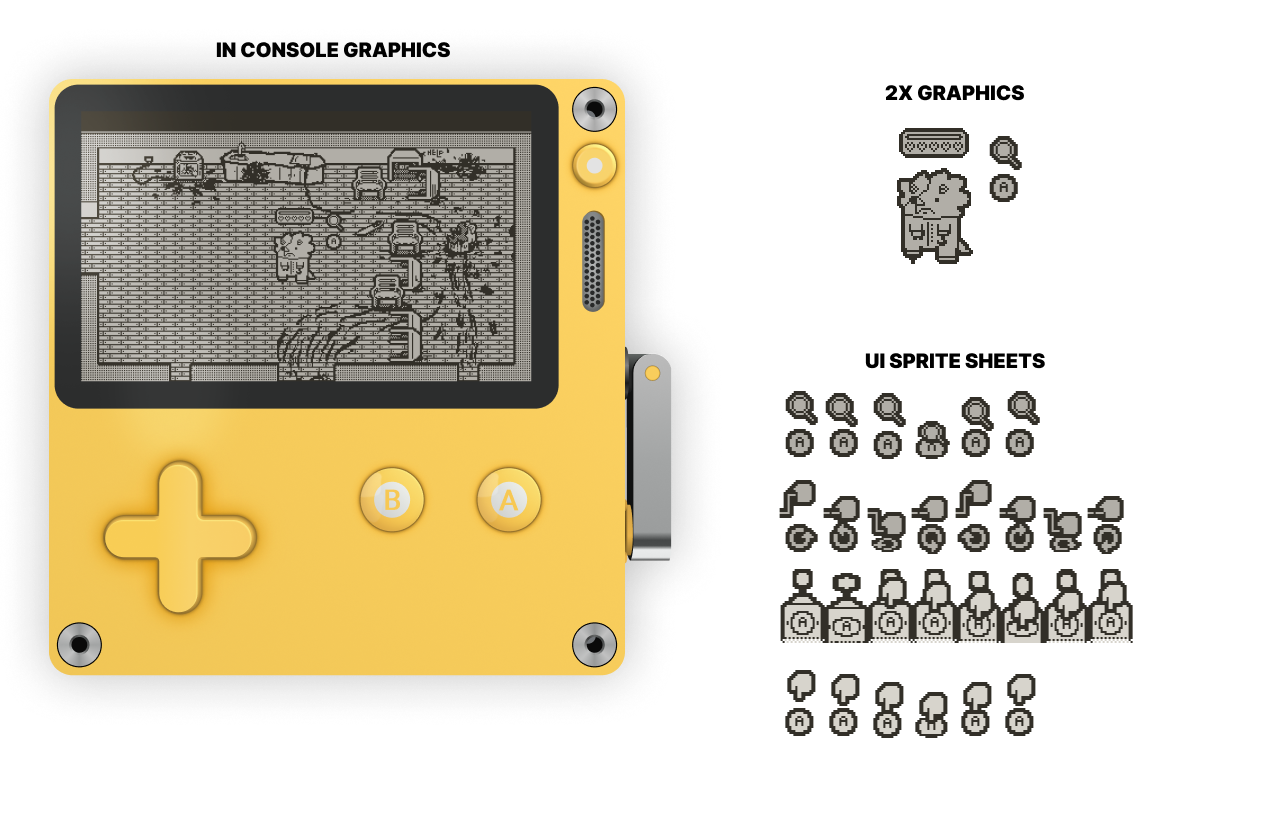
The Playdate screen is 400×240 px. That is not a typo. Designing a game UI for that canvas means every element has to earn its space. Health indicators, skill cooldowns, dialogue boxes, menus, all competing for a rectangle smaller than a credit card held sideways.
The in-game menu was rebuilt multiple times. The final version uses a layered approach: minimal HUD during play, expandable on demand. A single button opens and closes it. The challenge was making it feel fast enough that players didn’t avoid using it.
Engineering
“Time Moves When You Move”
Enemies and NPCs only run their AI when the player acts. The decision was driven by two constraints at once: maintaining the game’s turn-based feel, and keeping CPU usage minimal on a device with no GPU and a 168 MHz processor. Preserving that contract consistently across every mechanic (combat transitions, hole falls, sliding, dash, projectiles) without edge cases breaking it was one of the most persistent engineering challenges throughout the project.
Rhythm Combat System
Touching an enemy triggers a full rhythm encounter: button prompts scroll toward a hit zone, the player presses the matching input in time, and a balance bar shifts toward a win or lose threshold based on accuracy. Difficulty is determined by a probabilistic weighted roll across three player stats (sanity counter, power level, and calories burned), producing organic difficulty escalation without hardcoded curves. Each of the four enemy tiers runs at a higher BPM with more simultaneous prompts, scaling from 4 buttons at 16 BPM up to 12 buttons at 32 BPM.
LevelGenerator
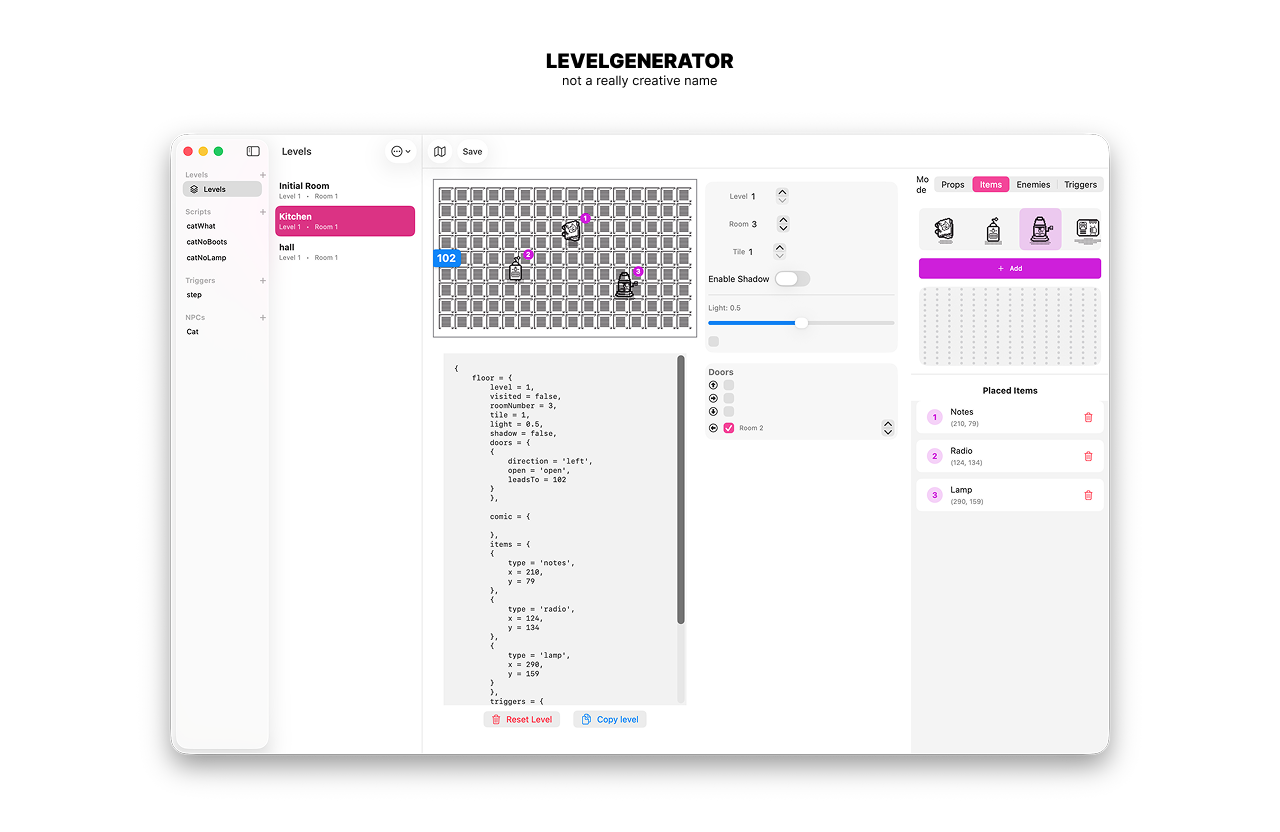
Placing enemies, props, and room connections by hand in raw Lua was unsustainable. LevelGenerator started as a simple SwiftUI map canvas, where you drag items onto a grid, configure four-directional doors, and export. But the real gap it filled was elsewhere: dialog, scripting, and triggers were things the game’s own code couldn’t absorb cleanly from LDtk’s output. The tool grew to meet each need: first dialog scripts with their sequences, then a conditional script system that evaluates player state at runtime, then a full trigger hierarchy, then NPC entities with their own script references.
The result is a cross-platform SwiftUI app (iOS + macOS) built entirely on first-party Apple frameworks. A single observable store owns all levels, scripts, triggers, and NPCs, and exposes stable UUID-based bindings so the UI never goes stale on index shifts. The export layer generates Lua tables the dialog engine reads directly, with no conversion step between design and runtime.
BitSummit 2025
In July 2025, I brought the game to BitSummit in Kyoto, one of Japan’s biggest indie game events. It was not finished. It was never going to be finished in time, and I went anyway.
Fellow Playdate developers played it. They played it for about five minutes, which is the correct amount of time for a Playdate game. They liked it. They told me to ship a demo. I shipped the demo.
The demo went up on itch.io without announcement. Shadow-dropped. The goal was closure, a line under a chapter that had been open for too long.
Someone bought it. Not a friend. A stranger. That was the first dollar.
Unity / Steam
The Steam version is a different game built on the same universe, developed by a team in Chile. TriceraTreasure Tom (TTT) is a disgraced Dinopirate captain demoted to janitor after an alien invasion destroyed his crew. The game is a top-down action roguelike: each run builds a different loadout from paleolithic weapons and dino-tech, permanent progression carries between runs, and the arc climbs from janitor back to captain.
My role on this version was art direction, character design, and UI, not engineering.
Art Direction
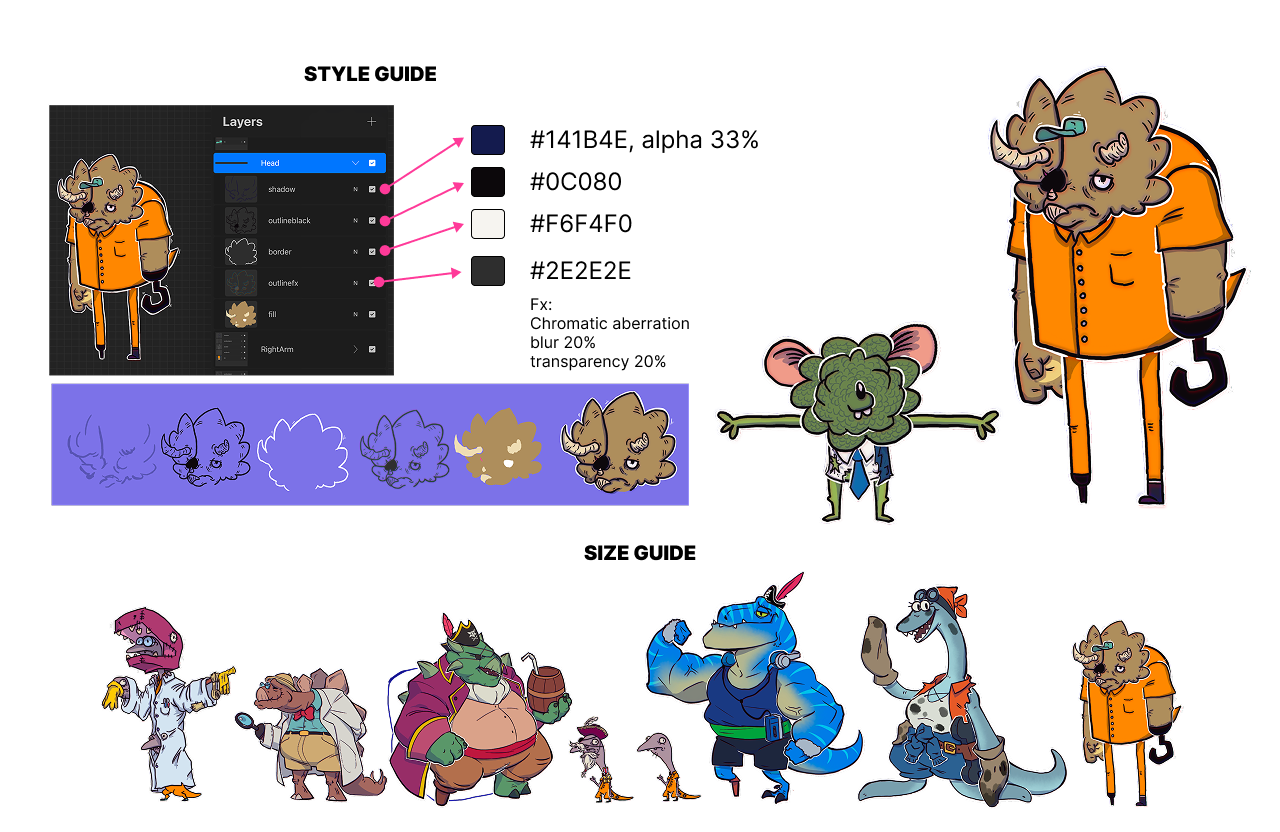
The visual tone is 90s action cartoon: loud, committed, absurdist without losing narrative stakes. Where the Playdate version communicates entirely through shape and timing, the Unity version has color, animation, and full character expression. The constraint flipped: instead of reducing to the minimum readable form, the challenge was maintaining a coherent identity across a wide range of assets, enemies, and environments without it dissolving into noise.
UI & World Building
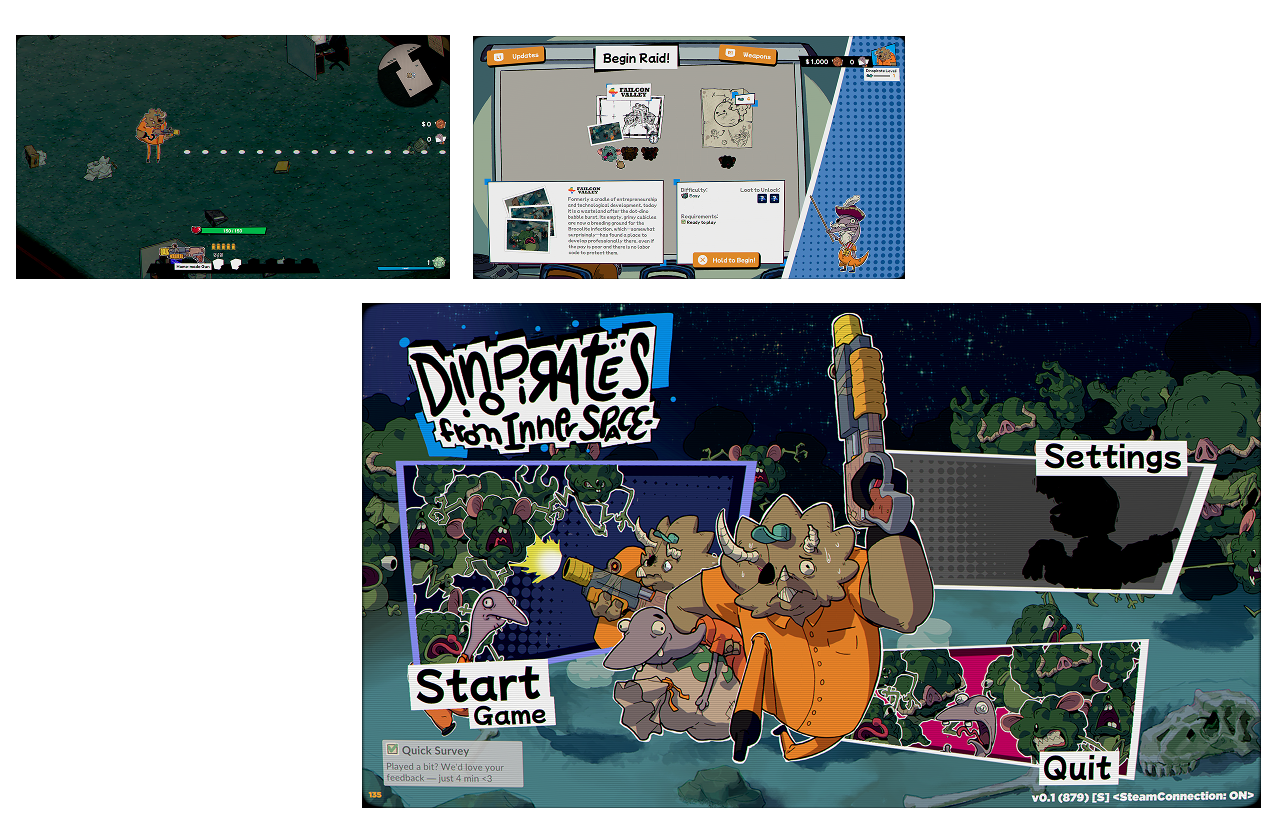
The roguelike structure introduces UI complexity that doesn’t exist in the Playdate version: run summary screens, build selection, crew management, progression tracking. Each screen had to feel like part of the same pirate universe without losing clarity for a player mid-run.
The Inner Space is a sci-fi setting that explains itself through the game’s fiction rather than exposition: the Dinopirate hierarchy, the alien Brocolite invasion, the mutiny arc. World building here is a design constraint, not a writing exercise. It determines what UI elements exist and what they’re called.
Learnings
Constraints are a design tool, not a limitation. The 1-bit palette, the tiny screen, and the crank as primary input forced every design decision to be intentional. No room for decoration. Every pixel had a reason. That discipline transfers directly to the Unity version, and to any project.
Ship to close, not to finish. The Playdate demo was never “done.” Releasing it anyway, with BitSummit as the deadline, created a forcing function that self-imposed deadlines never had. Shipping gave the project an end, which is the only way to start the next one.
Know when to build and when to adopt. The first custom level editor was a mistake. LDtk exists and is better. Replacing it saved months. LevelGenerator fills a different gap: game-specific scripting, conditional dialog logic, and direct Lua export that no off-the-shelf tool provides. The distinction is whether a better alternative already exists.
Same IP, different discipline. Designing for Playdate and designing for Steam are not the same job. The Playdate version is an engineering and constraint problem. The Unity version is an art direction and systems problem. Owning both made each one sharper.
Community validates before launch does. The five minutes of playtime at BitSummit told me more about the game’s feel than any amount of solo development. Get it in front of people early. The feedback you need is not on your hard drive.